Discovering the world on $20 per day ......................


Post 357: Ban Pai, Central Thailand

The days here in the village are broken down into distinctive elements. Everybody wakes rudely early with the cockerel, who for some reason has been calling through the night, and rides down to the temple. The morning chorus of scooters bursting into life heralds the start of another day. The local temple is only fifty yards from the house but nobody ever thinks about walking. The early morning light has a purple tint and smoke from the nights mosquito repelling fire still fill the air. If there is a cooler part of the day or night, then this is it. Make the most of it because it wont last long. The monks look fresh and alive but the people seem a little hung-over …. and that’s probably because they are. “Na mo at sa, pa ka ra toe, ah ra ha toe, sam ma, sam pud at sa” …… the ritual prayers begin.


Souls saved and good fortune sought, the day turns quickly to it’s second element: Food. Food -discussion, preparation and eating - is an all day event. It starts with a regiment of household scooters making for the markets in the town of Ban Pai. Not yet 8am and it’s already busy. People fill every narrow isle in the confusion of stalls but are still outnumbered by the flies. Some stall holders swat the little pests away with sticks and brushes, but most don’t bother … the flies will always win.


Fresh vegetables from the grocery market and eggs from the hardware stall. I’ve no idea why the hardware merchants sell eggs, but they do and people just laugh when I ask the question ’Why?’ Eggs are expensive these days, a consequence of mass culling to prevent the spread of bird-flu, but people still buy them. ’Kai’, they love their eggs in these parts.

From the hardware market onto to the fresh fish market. Very fresh, everything is alive and despatched to order. No returns, no refunds.


Then onwards to the fruit market, my favourite place. Flies have a sweet tooth so their numbers are greater here, but it’s also the place where we buy my favourite food. Mango with sticky coconut rice, “Muang kow meaow“. I’ve eaten this dish all across Souteast Asia but this stall seels the best that I’ve ever tasted. The yellow skinned mangos are always perfectly ripe and the rice just drippes with sweetened coconut milk. The vendor always calls me her son and smiles the famous Thai smile. Unfortunately it’s only a flash of gums that speaks volumes about the sugar content of her product and her dedication to enjoying it.


A day of cooking and eating follows and as the sun sinks down into the distant paddy fields, it’s time to return to the temple. In the evening, the young novice monks wait patiently to be anointed with cold water scented with fresh flower petals. The evening air if filled with the fragrance of incense as joss sticks smoulder everywhere. Most of these boys will not become monks, but every Thai male spends a certain amount of time as a novice at their temple. It’s a traditional right of passage and entering and leaving the order is a reason to celebrate.


So in the evening we celebrate. I don my finest Song-Kran shirt, which I surprisingly found in the ’Men’s Department’ and another night of gentle partying begins….. Mai pen rai kap


Post 356: Song Kran Festival ... Ban Pai, Thailand

From Phitsanulok we drove for an hour and arrived in a small village just a few miles outside of Ban Pai. The village probably has it’s own name, but I honestly don’t remember anybody ever mentioning one. The village kids were already prepared for their day of fun. Standing at the side of the quiet road, a huge ceramic urn filled with water and scoops with which to throw it onto any passing person or vehicle.

The first vehicle was an Isuzu D-Max, filled with soaking wet girls and armed to the hilt with high powered water guns. The kids of the village didn’t stand a chance and if there’s one thing that I hate, it’s an unfair battle. I borrowed a Honda Scoopy and made a dash for the town of Ban Pai, taking the back roads and avoiding most of the soakings.


An hour later, I returned to the village with no name and distributed my purchases amongst the kids. 500 Baht had bought me a veritable arsenal of water weapons. The village with no name was now the mightiest fighting force in all of Central Thailand and beware anybody who approached.


The day was hot but the water was cold. Everybody who passed along the road got a refreshing welcome and the kids were revelling in aquatic heaven. But the road was too quiet, too few victims.

It was time to mobilise the troops and take to the back of a D-Max. A mobile fighting force the likes of which has not been seen in these parts since the time of King Naresuan himself. We were invincible.


And as night fell, it was time to party …. Thai style …. With a little touch of San Francisco … mai pen rai kap


Post 355: Phitsanulok ...

The bus journey to Phitsanulok took almost six hours. That’s an hour longer than the timetable suggested but for these parts, that’s pretty much on time. It wasn’t the VIP coach that I’d promised myself, but at least I had the luxury of a seat. The ‘undeclared’ passengers who boarded the bus a few miles outside of the official bus stations didn’t, but the driver was a little richer from their trade. The same thing happens on every long-distance bus journey in SE Asia and as the illegal’s board you can almost hear the blind eyes blinking back at Bus Company HQ. I guess it’s just a way of getting people to work for a minimum wage where ’minimum’ means exactly that …. mai pen rai kap

The bus kindly dropped me in the centre of Phitsanulok where the local tuk-tuk drivers were waiting to transport me to any place that I really didn’t want to visit. The Toyota Corolla Taxi hasn’t reached Phitsanulok yet and thankfully, nor has the attitude of Bangkok tuk-tuk pilots. Of course they wanted to take me to places where they’d receive a small commission for their services; a gem factory, a tailors shop or a family members restaurant, but after a little persuasion and the handing over of 50 Baht, I was transported in swift but cramped discomfort directly to my hotel, The Riverside. A good friend by the name of ’Nongnoo’ just happened to come from a village close to Phitsanulok and when I’d mentioned my travel plans she’d offered her services as my tour-guide. Of course I could have declined her kind offer, but although I might be slow at times I’m certainly not stupid. Her first act had been to select the hotel and hotels of The Riverside’s standard shouldn’t be cheap. But this one is, £9 per night for a room large enough to hold a dance and with great views across the river.

The first act was to visit the Temple of the Beautiful Buddha. Legend suggests that this is the temple that inspired King Naresuan to his great victories against the Mon, who I think were actually the Burmese. It was indeed a fine temple, and amazingly busy with people. They seemed surprised to see a Westerner in their temple but by now I’m getting used to that. With a genuine smile, I let them touch and poke me, answered their questions and falsely promised to ‘add’ them as my friends on Facebook. Curiosities completed, I’d approached the young monk for a blessing and repeated the standard Buddhist mantra three times .... ‘’na mo at sa, pa ka wa toe, ah ra ha toe, sam ma, sam pud at sa’’ … I’d absolutely no idea what I was saying but the monk seemed happy to see that I’d learned some of the ways of his chosen path. He’d grinned an abundance of gold, bowed his head and begun another chant expecting me to respond in the right places. Ok …. you win dude.


Mantras completed, he’d showered me with water from his holy brush, tied a white cotton band around my wrist and it was time to make way for the others who had gathered behind me.

I moved to the centre of the Temple and could see that the golden image of Buddha was beautiful, but whether it was any more beautiful than any other statue I’ll let others decide. I shook the small container of sticks and waited until one fell to the ground. The stick had a number on it which corresponded to a number on a range of different ’horoscopes’. It was all written in Thai and I didn’t understand a word. Nongnoo offered to translate but I knew that she’d only tell me the good stuff ….. It’s the Thai way, mai pen rai kap


Outside beneath the searing sun, I joined the line of people waiting to cleanse the smaller statues in the courtyard. Tomorrow is the first day of the Song Kran Festival. Traditionally Song Kran marks the end of the dry season and the coming of the rains. People took the remains of their stored water and used it to clean the temples and statues in the hope of receiving good fortune for the coming year. In more recent times Song Kran has become a festival more noted for water fights and partying ….. and I’m certainly not against progress.


Back on the main walking street in Phitsanulok, the pre-Song Kran party is in full swing. Amazing aromas fill the air, food of every kind is being cooked on the streets and every person in the city is joining in the fun. I buy a dancing ticket for 20 Baht and as the music changes, I choose my grandma to dance with. It’s fun but I haven’t got a clue what I’m doing. Every turn of the hand or foot has a different meaning and I’m probably being amazingly rude, but the money goes to the temple and I’ve had much more expensive dances in my time.


At the end of the street, the grounds of the monetary have become a fairground. The saffron robed monks are in charge and above a shallow pool of water, kids are knocking the crap out of each other for the entertainment of their parents. Well, really for the entertainment of their fathers who are taking bets on the eventual champion. Money is changing hands, thick wedges of Baht are being wagered and in the best out of three contests, fathers are acting as coaches and scolding their beaten off-spring. I’m sure the losers don’t really get hurt, at least not until they get home …. Mai pen rai kap


As the clock ticks well past midnight, the crowds slowly start to leave, but not before a final tasty snack. Tak-A-Tan, otherwise known as deep fried cicada or cricket. The trick is to just crunch into it and swallow after the minimum number of bites. The cicada are quite easy but the legs of the stick insects get stuck everywhere and are really well worth avoiding. Apparently a daily serving of such insects is good for a mans desire and virility, but then they say the same thing about oysters. Hopefully I don’t need any help in either of those areas …… but when in Phitsanulok !!! ….. Mai pen rai kap


Post 354: Taking the Bus in Thailand .....

Here in Thailand most Westerners, or to give us our local name, ‘Farang’, seem quite happy to take internal flights and taxi’s, but steer clear of using other methods of public transport such as buses and trains. I don’t think it’s always because of time or cost issues, it’s probably more likely to be a fear of stepping into the unknown. Obviously buses here are cheaper than flights but on the face of it journeys will take longer, and trains are cheaper than buses but will probably take longer still. On the plus side, if you learn how to use the systems then they’re both great ways to travel and you’ll inevitably meet more fascinating people along the way. So, in my search for Naresuan I need to travel to Phitsanulok about 450km to the north of Bangkok, and here’s a beginners guide to taking the bus in Thailand ….

Mo Chit is probably the largest and busiest bus terminal anywhere in Southeast Asia. It’s situated to the north of central Bangkok. Day or night, it’s a heaving mass of people travelling to all points of the compass but if you know where you want to go, then it‘s really quite easy to navigate the system.
All of the various bus services are numbered, in this case 25 to 32. Where the destinations are written only in Thai, it’s probably best to ignore them. If you’re not already familiar with travelling on Public Transport in Asia then these services will probably be a discomfort too far for you. Keep walking on the 1st and 3rd floors of Mo Chit until you see your final destination written in English. It will probably say ’Phitsanulok VIP’ and have a time and written price next to it. Through the glass screen, state your destination and they will show you a ’Departure Time’ and a ’Price’. There’s no need to haggle, it’s a bus station not the night bazaar and the prices are dictated by the level of service provided. Once you accept, they will show you a screen and you can choose your seat. I chose the 1st Class bus to Phitsanulok and the cost was around 250 Baht, £5. My ticket tells me that my bus will depart from ’Platform 46’ at 10:30am and that leaves me with an hour to kill in Mo Chit.


The terminal is on 3 floors and you will find sufficient fascinating people, shops and food outlets to keep you entertained. Trust the information on your ticket because there are no public service announcements in English, and even if you speak Thai the PA system is so antiquated that you’ll never understand them.


Everything you could possibly need for your journey is available within the Mo Chit bus terminal. The food is actually very good and if you can’t travel without a stuffed Doraemon toy or a fake Blackberry then you’re in luck, they have everything.


As your departure time approaches, follow the signs to your platform. It will take you outside onto the main departure concourse and there the platform numbers will be written above parking place. It’s hot and busy and although chaotic, it actually works really well.


Ten minutes or so before your departure time, a bus will pull into the parking bay. On the bus will be written the main destinations in Thai and English and on the side of the bus, the service number. The service number will match the number on your ticket. A member of the crew will check your ticket and attach a tag to any luggage that you don’t want to carry on board, exactly like air travel. Find your seat on the bus and as the hostess passes around the bottled water, smile politely, point at your ticket and state the name of your destination. That might sound a little childish, but trust me, if you haven’t visited that particular place before and it’s not the terminus for the bus, then you’ll have no idea when you’ve arrived. Don’t be afraid to ask.


On board there will be entertainment, usually a Thai movie and several episodes of the amazingly popular and crazy Thai comedy show ’Ching Loi Ching Larn’. The Thai’s like there entertainment loud, so unless you’ve brought your ear plugs then don’t expect to sleep.

The journey from Mo Chit to Phitsanulok takes five hours on the bus compared to one hour on a flight. However, you don’t need to check-in 2 hours before your flight or wait another hour for your bag and then a taxi journey to the centre of town. The bus will drop you right in the centre and now you’ve spent the same amount of time travelling but arrived a couple of thousand Baht richer and probably made some new friends along the way …. mai pen rai kap

Post 353: King Naresuan .....

I don’t make detailed plans. The 2nd law of thermodynamics tells me that everything in the universe starts out with high entropy (chaos), proceeds to low entropy (structure) and then inevitably reverts back to high entropy (chaos again). All of my travel plans start as a chaotic jumble of ideas that come together to form the perfect solution. The plan is perfect right up until I start to execute it and then it inevitably starts turning to shit … High Entropy to Low Entropy to High Entropy …. It’s an inescapable cycle and there’s absolutely no point in fighting it, so I don’t make plans.

So, after an eventful journey back from Hua Hin, my ideas of renting another bike were thwarted when the seasonal rains arrived early. They were wet and heavy and while I love riding bikes, I really don’t love anything quite that much. Ever since arriving in Thailand I’d seen posters advertising the latest blockbuster movie, “Naresuan”. I knew that Naresuan was a King of Siam, probably dating back to the 16th Century and that he had a liking for fighting on elephants. I wasn’t sure if he was real or mythical, but as every other person in Thailand seemed to have already seen the movie, I figured that it would be rude not to join them. I like going to the movies in Thailand because it reminds me of how things used to be back in Blighty; usherettes, Pearl & Dene advertising, standing for the national anthem and been shown to your chosen seat by a uniformed lady with a flashlight.

After watching forty-five minutes of Thai advertising and standing for the National Anthem, the movie began, three solid hours of it. The first thing that I realised was that this was in fact “Naresuan III” and I’d clearly missed the first two parts of the trilogy. The second thing that I noticed was a distinct lack of English subtitles. It was all in Thai and I understood barely a word of it. If I’d gone to the posh cinema in Siam Paragon then there would have been subtitles, but I’d chosen a provincial cinema in Lak Si and clearly English people didn’t tend to watch movies in that neck of the woods. The cinema was crowded and I really wasn’t sure about the etiquette involved in leaving a movie of such national historical importance before the ending. So I stayed, along with everybody else, and in a strange way, it was absolutely fascinating.

A little later research told me that Naresuan was born in Phitsanulok Province around 1555 and was King of the Ayutthaya region of Siam from 1590 until his death in 1605. As a King, Naresuan was most noted for his military campaigns and his struggles to free his people from Burmese oppression. I can remember being fascinated by the hundreds of headless Buddha statues during my earlier visits to the ancient temples at Ayutthaya. It all dates back to the time of Naresuan and the destruction caused by the invading armies that he finally repelled.


The more that I read about Naresuan the more fascinating and complicated his story became. Unfortunately the information available on the internet is a little disjointed and sparse, so I decided to explore a little further, and a little more physically. Next stop Phitsanulok, the birth place of Naresuan and home to the ’Beautiful Buddha’ that is said to have inspired his great victories. It’s not really a ’Plan’ ….. but in the absence of a plan then it’s the next best thing.


Post 352:Hua Hin, Thailand

Hua Hin was Thailand’s first real ‘Beach Resort’ but with the emergence of Phuket, and the islands of Samui and Chang etc., it seems to have almost dropped from the tourist radar. Nestled on the Gulf of Thailand about 300 km South West of Bangkok, for some reason Hua Hin was a place that I‘d never visited. Maybe being so close to Bangkok I’d always assumed that Hua Hin would be similar to Pattaya, and that’s certainly not a recommendation. Anyway, I figured that as I was so close then it would be rude not to drop in and find out for myself. I’d intended to start my travels in the South of Thailand but with major flooding I didn’t want to become another well meaning tourist getting in the way of the relief efforts. So, looking at my map I decided that Hua Hin would be the most southerly point on this journey and with bike rental in Bangkok being so rare and expensive, I decided to take the train.

It’s a three-hour journey and a 2nd class non-air conditioned ticket will cost you little more than the coins in the bottom of your pocket. It’s a little chaotic but once you understand the system then buying the ticket and boarding the right train is really quite easy. Because this is Thailand, the train journey will probably take an hour longer than the timetable suggested, but by the time that you arrive in Hua Hin you’ll be ready for the holiday. Trains in SE Asia are fun, but relaxing they are not.


Hua Hin railway station is noted for it’s architecture and it really is quite beautiful in a very chocolate-box sort of way. It’s busy but in a very relaxed and laid-back sort of way and a great entry point into the town itself. The first impression is that Hua Hin is about as far removed from the flesh-pot flea-pit of Pattaya as you could possibly imagine and while I’m sure that there is a seedier side to the resort, it is definitely nice and discreet. The town itself is a huge market place that bustles along without the chaos or intimidation of the more tourist orientated towns and that gives it a certain charm and family friendliness that keeps you constantly smiling. It’s not intimidating at all and walking the gentle streets or riding scooters around the area is an absolute breeze. Hotels in the town are plentiful and can accommodate most budgets. In the centre of town I find a small hotel with air-conditioning and a balcony for around 800 Baht, $10 per night. It’s clean, it’s friendly and as with most hotels the restaurant is probably quite abysmal but as this is Thailand you’ll probably be eating out on the streets anyway. The beaches however are perhaps not as free and inviting as those that you’ll find on many of the islands and those that have not already been taken over by the larger Hotels tend to by slightly more ’Industrial’ in nature. Another immediate thing that you’ll notice is a lot of Thai’s enjoying the beach, something that you don’t often find in the higher end tourist areas and for me, I always take that as a good sign.


In and around Hua Hin there isn’t the richness of temples and monasteries that you’ll find in other parts, but there is certainly enough culture and splendour to keep you entertained for a few days when you grow bored with lazing on the beach. The resort itself is spread along the coastline and unless you’re familiar with it, then local transport systems can be a little confusing. On the plus side, renting motorcycles and scooters is easy and a Honda Scoopy will cost around 200 Baht for a day, possibly including insurance but you never can tell, … this is Thailand after all. If you rent from outside of your hotel then you’ll need to leave your passport as security but in Thailand this is the norm and nothing to be too concerned about. If you’re going to be travelling away from Hua Hin on the bike then take photocopies of the passport, photo page and visa page, as these will be required for checking into other hotels during your stay. The people renting the bike to you will be able to provide you with the copies that you need. Although you’ll see many tourists and locals riding without safety helmets, don’t be tempted to do this yourself. The police will stop you and although the fine is quite small, it’s a pain in arse as far as administration is concerned. Anyway, Thai hospitals might be good, but you really don’t need to find that out for yourself.

The night markets in Hua Hin are busy and the food that’s served there is absolutely amazing. There are restaurants that serve ‘Western Menus’, but if you want to eat chips with everything then why the hell did you venture anywhere beyond Belgium? Don’t be afraid to try different local dishes and if you’re worried about the famous heat of Thai cuisine, then just ask the chef or waiter if it’s spicy … “Phet mai?”. The Thai answer will usually be a smiling “nid-noi”, but don’t worry, they want you to come back and eat there again so they wont try to force anything too hot or unidentifiable on you. Just try everything that you can and you might even surprise yourself.


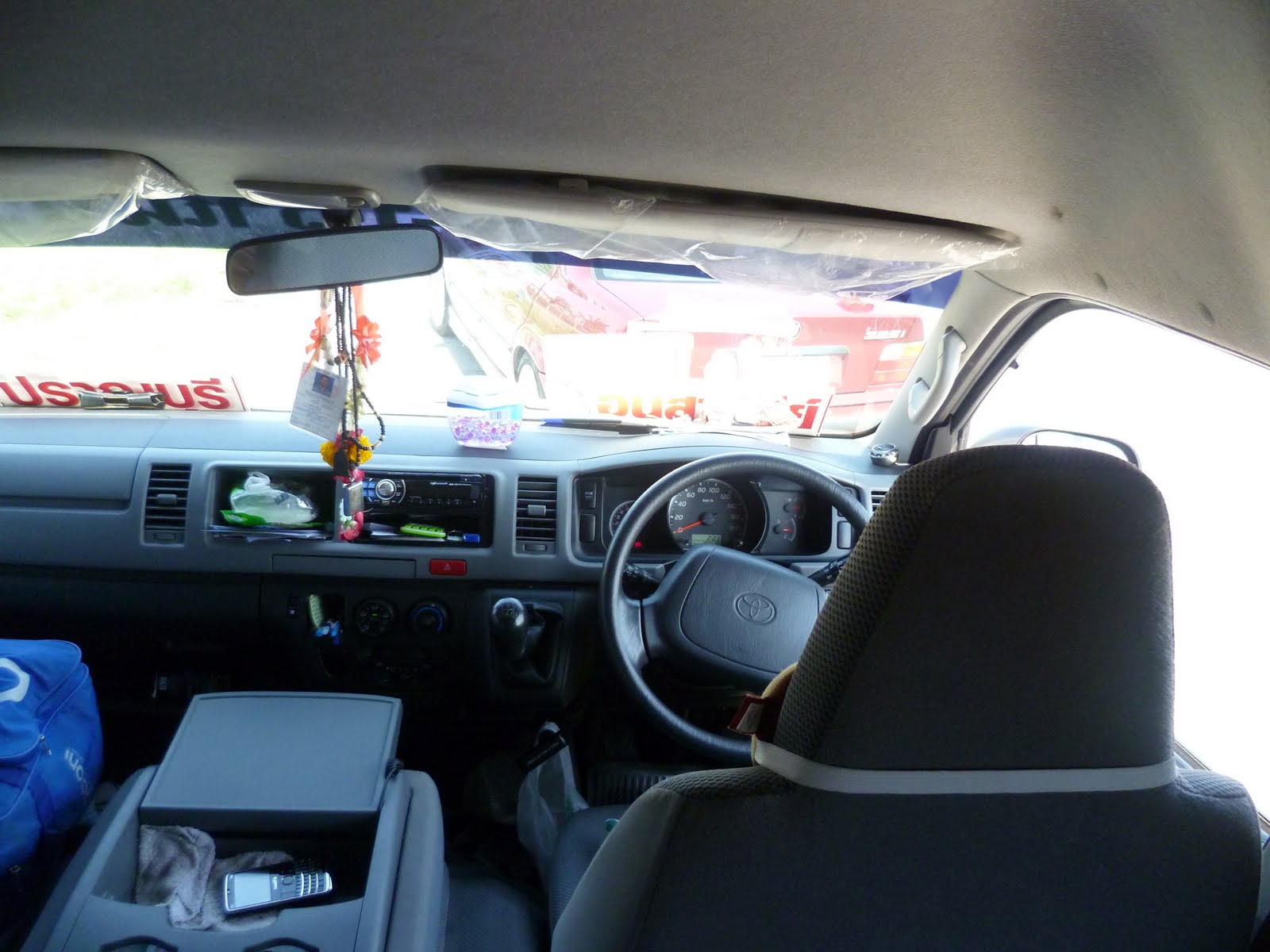
After a short stay in Hua Hin, I decided that I was suitably relaxed and it was time to head back to Bangkok. The train was an option, but you can only have so much fun in one lifetime and I decided to take a seat in a more relaxing Mini-Van. It costs almost $5 for the 3 hour journey, but unlike the train you’re guaranteed a seat. Hundreds of these white Toyota Mini-Vans run daily between Bangkok and the major resorts and you simply buy a ticket and jump on the next available seat. It’s usually an experience but there are some experiences that I never want to repeat.

I’m against the use of child labour, especially when the child in question is driving my bus. He was clearly old enough to be driving but he looked no more than 12 and drove his Toyota accordingly. All twelve passengers sat white knuckled clinging to their seats and gasping at his antics. Weaving, speeding, changing lanes without warning, undertaking and overtaking. I was the only Westerner and the Thai’s are too dammed polite to say anything, so I told him to slow down … and he ignored me.


A screech of brakes and the continuous hoot of a horn from the latest cut-up car in the fast lane behind. A red BMW with an ’M3’ badge for show. The driver wasn’t impressed and forced the Mini-Van across to the hard shoulder where the youthful driver reluctantly stopped. The BMW driver was clearly an unhappy man and removed the Mini-Van driver from his seat through a barely open door. If the BMW driver was going to thump him, then it would be no more than the bus driver deserved, but when he opened his boot and pulled out a handgun …. the situation changed slightly.


The villain had become the underdog and while the Thai’s in the Mini-Van suddenly found things of amazing interest in their magazines, I donned the blue peace-keeping beret and harmony was quickly restored. I’ve no idea if the gun was real or loaded, but I guessed that the BMW driver was very unlikely to shoot me at the edge of a major highway …… I’m British don’t you know .. mai pen rai kap

Post 351: The Golden Mount .. Bangkok

The Golden Mount in Bangkok, or to give its full title, “The Golden Mount & Wat Srakesa Rajavaramahvihara” stands at the highest point in the city. As Bangkok is about as flat as Lincolnshire that really doesn’t say a great deal, but I’d always assumed that the peak was a natural feature. I had no reason to believe that it wasn't natural, it’s massive and obviously arrived here long before diesel engines and JCB’s. But it’s not, it’s actually man made, every last inch of it.
The temple complex at the bottom dates back to King Rama I and the foundation of Bangkok as Thailand’s new capital city in around 1782 (Thai year of 2325). During the 19th century King Rama III made several attempts at building a large Chedi structure on the site but because of the softness of the underlying earth, each attempt had failed and the partly constructed Chedi had collapsed. In desperation Rama III had ordered that a mount ’this big’ be built using mud and bricks to support the proposed Chedi. It seems that back in those days what Thai King’s wanted Thai Kings got, because as hills go this one is really quite substantial. In the end, the tall golden Chedi wasn’t added until the early part of the 20th century so I guess it’s safe to say that even the demands of supreme rulers can take time to complete.


The Chedi is the golden cone that sits on top of the mount and are often referred to as a ’Stupa’. There might actually be a difference between a Chedi and a Supa, but aside from geographical terminology, I’m really not aware of any. It seems that if the sturcture is shaped like your little finger, then it's a Chedi and if shaped more like your thinb, then it's a Supa. Chedi and Stupa, of which there are more than two hundred thousand dotted around the world, are all supposed to house 'Relics of The Buddha', usually a part of Buddha’s cremation ashes and are therefore places of pilgrimage. The Chedi on top of The Golden Mount contains relics that were donated to King Rama V by the British, and we no doubt stole them from India or Sri Lanka. It does make you think though ... if there was only one Buddha but there are two hundred thousand Chedi?


The best time to visit The Golden Mount is probably during the festival of Loy Krathong which takes place around the third weeks of November. The whole Mount is draped in red cloth and thousands of people join candle light processions walking the 318 steps to the summit. Loy Krathong is principally a religious festival, but don't let that put you off because as with all festivals in Thailand, they’re never without a decent party.


When I first climbed the Mount back in 1987 (ish) the view from the top was quite different. Back in those days all that you could see was smog, lots of it, thick and unlovely. There were very few high rise buildings to compete with the Mount back then, but it didn’t really matter because you couldn’t see anything anyway. Since then, although traffic density has probably increased ten-fold, most of the commercial vehicles now run on cleaner LPG and the air in Bangkok is actually quite fresh and clean. The fragrance on the Mount can be quite amazing with scent from the blossoms and incense filling the air and leaving a lasting impression. It seems that not too many Western tourists visit this place and that’s a shame. Maybe the fact that it’s a working monastery puts people off coming here, or maybe it’s the 318 steps? Whatever the reason, it certainly isn’t the entry price. Thai of not Thai, it costs just 10 Baht ( 10 pence ) to visit the Chedi so if you do manage to make it up all of those steps, please place a one hundred Baht note in the donation box in order to ensure that sites like this remain accessible to those who could simply not afford to pay any more.


One word of caution though, The Golden Mount is just a stones throw from The Grand Palace, and it seems that the 'Tuk Tuk Mafia' are becoming even more brazen in their attempts to fleece the unsuspecting tourist. If anybody ever tells you that The Golden Mount or The Grand Palace are closed for 'Special Prayers' or a 'Royal Visit' during daylight hours then ignore them, because it’s generally utter bollocks. They’ll offer, for a small fee, to take you on a tour of local attractions and upon your return, the Mount or Palace will be open to tourists once again. Their 'Tour' will inevitably include a visit to a Gem Store and a Tailor, the owners of which will probably show a remarkable resemblance to the person who told you that it was closed in the first place …. Mai pen rai kap


Post 350 Going pots in Siam

About 10 miles east of Korat in Central Thailand, is the district of Dan Kwian. For longer than anybody has cared to write things down, Dan Kwian has been Thailand’s centre for the production of pottery and ceramics. It’s not really signposted, but then maybe it is but the signs might all be written in Thai and unless the sign reads ‘Beer’ or ‘Puncture Fix’ then I’m just a little bit clueless. It’s easy enough to find, just head towards Udon Thani on the main road and all of a sudden the roadside markets stalls will change. You’ve now reached Dan Kwian. For a distance of around 2 miles both sides of the main road are saturated with ceramic outlets of every size. Don’t be fooled or put off by the bling fairgroundesque offerings that are displayed at the roadside. The garish stuff is only there to provide colour to draw in the passing traffic and the good stuff is hidden away behind it.
Pots and vases of every size and shape are produced on site by artisans using local clay. They tend to be family run small businesses with different members of each family learning a different skill necessary for producing the end product. Some outlets have their own turtleback kilns that are fired once a week, seemingly always operated by the men of the family. That’s probably not because the men are any more skilled than the women, but if they’re only working one day a week then it gives them more time for general idleness and drinking, which can often be the Thai way.


If you can discover the right outlet, and find out who is in charge, then they’ll produce absolutely anything to your own specification. If you don’t have your own specification, then show them a picture of Clarice Cliff, Joy Navastie, Moorcroft or even Troika and a week later, it‘s yours. Personally I love the big vases and urns that they produce here, but it’s a question of how to get them home and then finding a home to actually put them in. The other thing of course is the price. A one metre tall vase will cost around 800 Thai Baht or $20 for a single piece ….. and around half of that if your buying in quantity. There’s got to be a new business in there somewhere for me … mai pen rai kap

Post 349: Bankers & Bushido ....

First came the earthquake, level ‘9’ on the Richter Scale. That’s ten times stronger than an ’8’ and a hundred times stronger than a destructive ‘7’. Ten minutes later came the 30M tall, 400kph wave. It wiped away everything in its path and engulfed the nuclear power station at Fukushima. Fusion reactors operate at amazingly high temperatures and the force of the wave took out the primary and secondary power supplies to the cooling pumps. The fuel rods overheated, the pressure built up, the walls of the reactor houses eventually exploded and Japan declared a state of emergency on three separate fronts.

With radiation levels rising and every attempt to resurrect the aging water pumps failing, a small group of nuclear engineers held up their hands and volunteered to continue working in close proximity to the deadly reactors. I believe that there are nineteen of these brave souls and given that they already worked in the Fukushima plant, then I assume that they’ve already lost homes and loved ones to the earthquake and tsunami. These brave nineteen are fully aware that what they are doing today will inevitably result in early and painful deaths for all of them. In order to save their fellow citizens from the toxic mess, that without their efforts would undoubtedly be far worse than it already is, these amazing average-income employees are making the ultimate sacrifice. Never before has so much been owed by so many to so few.


The last case of toxic mess was the banking crisis, but in that fiasco there was a distinct lack of Bushido. The bankers who created that disaster off-loaded the toxic debt onto all of us citizens, collected their bonuses and saved their own souls. Never before has so much been owed to so many by so few. At this moment in time those responsible for the international financial crisis should be hanging their heads in shame, but unfortunately they’re not. No sooner had the tsunami hit the shores of Japan than the bankers were short selling Japanese stocks and making a very different kind of killing. If there was ever a referendum on the introduction of a law against ’Financial Genocide’ then I know exactly where I’d be making my ’X’.