Discovering the world on $20 per day ......................


Post 374: 'In the Shadow of The Tiger'


Rolling into remote Asian villages aboard the Triumph Tiger 955i, I tended to get noticed. Shoulders back and head held high, the Tiger growled and the people smiled and waved. I’d pull to a dusty halt, kill the engine and become the instant focus of attention. A hundred familiar questions would greet my arrival: ‘How fast?’ ‘How big?’ ‘How far?’ ‘How much?’ Cameras would click as adults posed for photographs beside the orange beast while every kid in town looked longingly towards the Tiger’s empty pillion seat. 
Along with the genuine warmth and hospitality I’d actually enjoyed the attention, but as the miles had increased I’d realised that something important had been missing. The people passing fleetingly through my life had probably learned a great deal about my nomadic existence aboard the impressive Triumph Tiger, but their understanding of ‘Me’ had done little to improve my understanding of ‘Them’. 

Four years earlier in London, my journey had started as little more than a self-indulgent jolly, a magical remedy for mid-life mediocrity, a low-rent Long Way Round that owed far more to POORATECH than TOURATECH. However, somewhere along those dusty roads heading east, the nature of the journey had changed. I don’t remember a particular milestone on the road nor a precise moment in time, but what had started life as a ‘Motorcycle Journey’ had somehow transformed into a ‘Journey by Motorcycle’. 

I was beginning to understand that what I was witnessing along the way wasn’t a true reflection of life, but a performance of life staged purely for the benefit of the foreigner with the big shiny motorcycle. In every home that I’d been invited to enter, of which there were many, there’d always been a metaphorical elephant that I’d wanted to learn much more about; poverty, politics, inequality etc. But, in every home and village those elephants had been hiding in the shadow of the ever dominant Tiger. My European motorcycle had certainly opened the gates to remote communities in the middle of everywhere, but it had done so with the subtlety of a battering ram. In order to break down the barriers between myself and the communities that lay ahead of me, I needed to replace that battering ram with a much more sensitive key. In order to understand more about the real lives of those I was yet to meet, I realised that I needed to slow down the pace, become more anonymous and to start passing through the lives of others rather than simply allowing others to pass fleetingly through mine. 

The Triumph Tiger 955i was an amazing motorcycle, but it was just a little too rude and conspicuous for my changing needs. There was no alternative, it had to go, but parting certainly wouldn’t come easily.  Back in 2008, I’d explained my initial travel plans to the good people at Triumph Motorcycles and they’d offered me some quite unusual advice: ‘The Triumph Tiger won’t make it around the world. It’s just a street bike dressed up in an adventure frock, so we’d advise you to buy a BMW’. Fifty thousand miles, thirty-five countries and several continents later, having witnessed modern BMW’s and KTM’s expensively self-destructing across the wilds of Siberia, my only real mechanical failure had been a blown headlight bulb in Vladivostok. That’s not too shabby for a simple street bike wearing an adventure frock, but the time had come to start shopping for a more appropriate ride. What I needed was a simple and reasonably priced motorcycle, something that would blend into the vast Asian landscape and hopefully go unnoticed.   
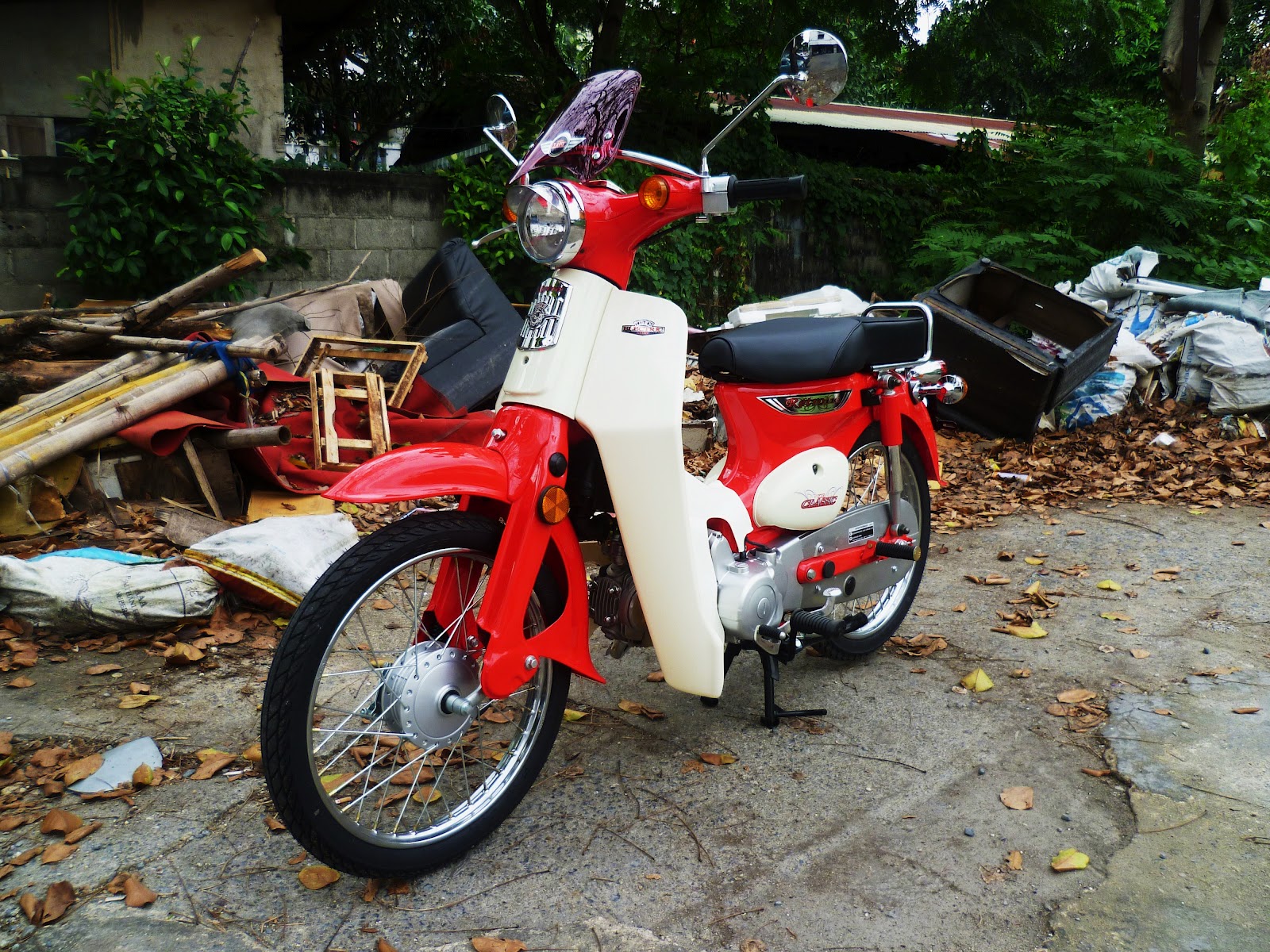
Exactly four years after setting out from London on the Triumph, I’m now riding through the chaotic streets of Bangkok aboard a brand new red and white motorcycle. I’m five hundred pounds poorer, but I’m riding the most amazing motorcycle the world has ever seen. It’s certainly the most highly produced vehicle in history, and therefore I hope, the most anonymous. It’s the motorcycle that quite literally changed the world, the motorcycle upon which you’ll meet the nicest people, the iconic Honda SuperCub C90. However, I’ve just bought this little SuperCub in Bangkok, an absolutely amazing city, but a city where things are seldom what they appear to be. Despite the fact that I bought the motorcycle from one of Bangkok’s premier Honda dealerships, it’s not actually a SuperCub, in fact, it’s not even a Honda. I’ve just purchased a Tiger Retro 110, a Thai manufactured copy of the 1960’s SuperCub C90, or as the Tiger Motorcycle Company of Thailand prefer to call it, ‘a faithful reproduction’. However you’d like to describe it, and I’m sure that Honda purists have some colourful descriptions of their own, it’s time to see if this motorcycle is the sensitive key that I’d hoped for.

It’s the second week of April and the beginning of Thailand’s Song Kran Festival, the festival that marks the end of the dry season and the coming of the monsoon rains. Traditionally this was the time when rice farming villagers in the North would take the remainder of their precious water to the temples and use it to cleanse the images of Buddha. In return for their offerings, they’d hope to receive good rains and good fortune for the coming year.  Traditions such as these are often the earliest victims of progress, and in recent years Thailand’s economic and structural progress has been remarkable, but when it comes to fitting square pegs into round holes, the Thai’s have an uncanny knack of making such unions seem quite natural. It was time for me to start finding out if Thailand’s progress had been kind to its culture. 
A few kilometres into my first journey on the smile inducing Tiger Retro 110, I turn away from the main highway and steer gingerly into the temple at Lak Si. Thai’s are very fortunate people. As Buddhist’s they can look forward to the possibility of enjoying many consecutive lives, but as an atheist I’m well aware of my own mortality and I'd like to see my one and only life continue for as long as possible. ‘A faithful reproduction’ is probably a fair and accurate description of the Retro 110, because the Tiger Motor Company seems to have successfully captured the essential essence of the original SuperCub C90, especially it would seem, its ugliest warts. With 1960’s leading link front forks, rear suspension that prefers shocking to absorbing and a front brake that’s bordering on useless, I temporarily discard my atheist leanings and seek a helpful blessing from the monks. If I’d arrived here on the big Triumph there’d be great ceremony now; tables laden with food and drink, beating drums and ringing bells and strings of fragrant orchids with the Abbot Monk centre stage in his finest saffron robes. Today, the three novice monks finish contemplating the sports pages of their newspaper, take the final draws from their cigarettes and only then, rise to assist me. ‘Na-mo ta-sa, pa-ka ra- toe, ah-rah ha-toe, sam-ma, sam-pud ta-sah’.  Three times they repeat the traditional Buddhist blessing before sprinkling the Retro 110 with water and tying a simple white string loosely around its throttle. The little scooter has passed its first test. It’s been blessed as any normal Thai scooter would be blessed. Our future happiness and safety is assured and the road heading north now looks a little less daunting.
An hour after leaving Bangkok, I reach Ayutthaya, the ancient moated capital of Siam with its magnificent temples and countless images of Buddha. The recent flood waters have subsided and restoration work is well underway.  High on ancient bamboo scaffolds, Thai workers toil beneath the burning sun, executing ancient skills with the most modern of cordless power tools. Below them, the early morning tourists are looking uncomfortably hot; sweating, wiping brows and complaining about the smell, the noise, the bugs and the heat. They seem oblivious to the fact that just a few weeks earlier these amazing structures, and no doubt the homes of those repairing them, were drowning beneath several metres of putrid flood water. But why should they know and why should they care? Thai’s recover quickly, it’s in their nature, they just seem to get over things and get on with things far more easily than we ever could in the West. A solitary monk stands silently beside me, watching the same group of people and gently nodding his head. He’s probably also wondering why so many fortunate people seem to travel only in order to find new things to complain about, but as a monk he’ll probably keep those thoughts to himself. He glances down into my open notebook and then points towards the Retro 110, ‘SuperCub, it looks like new’. I tell him that it is new, but that it’s not a SuperCub, and that’s the end of the motorcycle conversation. We talk for an hour about his new life as a monk, and about his previous life as a wayward husband and absent father. The temple had been his saviour, taking him in and turning him around when life had seemed to have abandoned him. I’ve never before talked so openly or candidly with a monk, nor any other man of religion, but his duties at the temple are calling him and we go our separate ways.
The vast Central Plains of Thailand are absolutely flat, perfect for the limited power of the Retro 110 but I suspect not so effective when it come to the draining of flood water. I’ve ridden north from Bangkok for seven hours and the only hills that I’ve climbed have all been made by man. The Gulf of Thailand is at least three hundred kilometres to the south and probably less than a metre lower than where I’m standing right now. I’ve stopped in a small village to replenish the Retro’s three litre fuel tank and I chat idly with the attendant. I point to the traditional wooden houses built high on stilts, and then across the road to the modern western style bungalows with their concrete walls and front yards that are now littered with flood damaged furniture and white goods. The attendant shrugs his shoulders, replaces the nozzle and begins to explain. He lives in the traditional stilted wooden house, the house that was built by his father, naturally ventilated in summer and safe above the damaging flood waters. His daughter lives in one of the many modern western style bungalows, expensively air conditioned in summer and clearly susceptible to flooding. He doesn’t seem to blame anybody for these errors of progress, or even suggest that they should return to the old ways of building their homes, he just shrugs his weary shoulders and mutters the Thai equivalent of ‘whatever’; ‘mai pen rai kap’.    
A little further north, I enter the town of Phi Chit where the local kids are waiting to greet me. Passing every humble home, cafe or market, buckets of water are thrown over me and if I dare to stop, my cheeks are lovingly plastered with a white menthol powder. I haven’t been singled out for such refreshing attention, in fact, unless I lift my visor then they’ve no idea that I’m not Thai but it’s clear that they don’t discriminate. It seems that everybody, even the passing motorcycle policeman, is a legitimate target during Song Kran. The Thai tradition of cleansing the images of Buddha at Son Kran has progressed, and it appears that Northern Thailand is currently engaged in the world’s largest ever water fight. It’s fun and the kid's enthusiasm is addictive, so I park the Retro 110, grab myself a water scoop and join them until darkness dictates that we stop. 

I’m spending the night at the family home of my good friend Nongnoo in the small village of Ban Noen Kum. I sit down to eat dinner with grandparents, young nursing mothers and children of all ages. Aside from my friend Nongnoo and her nursing sisters, there’s nobody of working-age at the table, an entire generation seems to be missing. In fact, I don’t really recall seeing many people of working-age all day, aside that is from those who I’d actually seen working. I pose the question and the answer isn’t quite what I’d expected. I’m told that those who are able to work will be working throughout the whole of the Song Kran holiday. They go on to tell me that it didn’t used to be this way, entire families always came together for the festival, but in these days of easy credit and minimum monthly payments, the aspirations of parents have become the expectations of their children. Isuzu D-Max trucks, iPhones, plasma TV’s and Japanese scooters all cost money, money that’s readily available via Mastercard and Visa, so the workers work in order to keep up with their payments. Looking around me I can see exactly what they mean. Bright orange tractors have replaced the diesel powered tak-taks and grass powered buffalo that used to work the rice fields, everybody here has a phone that’s far smarter than mine, every wooden shack has its own large satellite dish and nobody drives a car that’s any older than the fashionable designer labelled clothes that they all seem to wear. Suddenly, I feel like the poorest guy in the village, but I’m not, I just don’t have as many credit cards. Asian, African, European or American, between us we have many differences, but it seems that we’re all now swimming in exactly the same dream pool.

Rolling into remote Asian villages aboard the Tiger Retro 110, I tend not to get noticed. Shoulders back and head held high, the Retro buzzes and the people simply ignore me and carry on with their everyday lives. I pull to a dusty halt, kill the engine and absolutely nothing unusual happens. Aboard the little scooter I’m blending in, an invisible part of the massive cultural landscape and able to observe without being noticed. Of course, once I park the scooter and dismount the people realise that I’m not local and ask their questions. But, the nature of their questions has changed. Unlike the Triumph Tiger 955i the Tiger Retro 110 isn’t important or special to anybody, it casts no unwanted shadows. A barrier between us had been removed and our conversations are now about the most important things in all of our lives: People and Life.


Post 373: Song Kran Festival 2012

The Festival of Song Kran had arrived again, April 13-15, formerly New Year here in Thailand but now little more than an excuse for merriment and a cursory visit to the Temple ....
It’s a time of year when Thai’s travel back to their home towns and villages, a time of year when buses, trains and aeroplanes are full ....
It was time to head up country and put some Kilometres on the Tiger Retro 110 ....
It was hot, uncomfortably so, so I dressed accordingly and enjoyed the odd splash of water from roadside kids ....
In fact, there was no escaping it ....
Invited or not, everybody becomes part of the national water fight ....
Unless you happen to be a Monk ... mai pen rai kap

Post 372: Asian Markets in Crisis

When I say ‘Asian Markets’, I’m referring not to Stock Markets but to grocery stores, small independent businesses, specifically those here in Thailand....

On and off for the past eighteen months I’ve lived on the very outskirts of Bangkok in an unremarkable housing complex containing 140 single room apartments for young professionals and small families. At a little less than £100 per month including all utilities, air conditioning, Thai cable TV and occasional WiFi, it’s probably quite representative of affordable city living for young Thai’s. The ground floor of the apartment complex is home to several commercial live/work units; two small restaurants, one laundry, a florist and two independent convenience stores, all of whom currently survive on trade from the residents......

This is not a unique situation but something that’s repeated in every suburb around the country. Community living where ‘community’ means exactly what it used to mean; local people running local businesses supported by local people, who they in turn support. Micro economies that react quickly to market needs and survive by offering excellent personal service and by always going the extra mile.  It’s one of the greatest reasons for living here, but it’s a situation that rapidly changing.......
For several years these small independent stores have faced fierce competition from major chains who have expanded into the market; 7 Eleven and Family Mart. However, things now seem to be changing more rapidly, thanks in the main to Tesco Lotus, the Asian arm of Tesco UK. They started with Mega Stores, which I guess was inevitable, but now their smaller ‘Express’ stores seem to be springing up all around us. 7 Eleven and Family Mart tend to be franchise operations owned and operated by local people, but Tesco Lotus I fear are not. Given Tesco’s alleged penchant for litigation, I’ll be careful with my words, but I do fear for the future of this small community and countless others just like it across Thailand.........


Tesco monopolising Thai grocery shopping, what next? ..... Monsanto taking over grain production in Nepal? .... Just a thought!     

Post 371: Honda Super Cub .. Tiger Retro 110

I'd seen them on the road, not in numbers that would overwhelm the more familiar Honda Wave's and Yamaha Fino's that travel the Soi's of Bangkok, but in numbers sufficient enough to make me sit up and take notice. The Honda Super Cub, without doubt the most iconic powered two-wheeler ever made, the bike that mobilised the world, the most produced vehicle in history, 53 years in production and more than 6,000,000 produced to date.   
I'd heard that Honda were reintroducing the Super Cub, but I'd only seen pictures, nothing in the flesh. In photographs the new Super Cub had looked lovely, but it was clearly a representation of the original and not a faithful reproduction. The Super Cub's that I was seeing here in Thailand seemed different to Honda's offering, more original, authentic and true to the original design.


Last year in Phitsanulok, I'd bought a beautiful pair of Converse shoes; comfortable, stylish and robust. They've served me well for a year of walking, riding and travelling. While treating them to a jolly good Spring clean I'd noticed something rather strange written on the side: 'COAVERSE' not 'CONVERSE'. Unless Converse are employing dyslexics in Quality Control, then clearly these beautiful shoes that I've loved and worn for a year are not original 'Converse' products. However, they cost half as much as the originals and with the exception of spelling, pass muster at every inspection.


When the opportunity came to get up close and personal with one of these bikes, I took it. Like my beautiful shoes, the only difference between this bike and a Honda Super Cub seems to be literate in nature: The engine side casings don't say 'Honda', but 'Tiger'. This is in fact the Tiger Retro 110, made in Thailand by the Tiger Motor Company in Bangkok. 

It's a faithful, and I assume legal, reproduction of the original. So much so that when the time comes to source replacement parts, you refer directly to the Honda Super Cub parts catalogue. Owners of original Honda Super Cubs might scoff at the this bike, but after a short test ride I fell in love with it, warts and all; low power, four clunky slick-shift gears, brakes to die from and suspension that ignores all advances in technology and knowledge. In a word, The Tiger 110 Retro is BEAUTIFUL. 

A couple of years ago I rode a Triumph Tiger around the world, now the question is ........
Where should I take this Tiger?

Post 370: Bangkok Ghosts II

A few weeks ago, I mentioned the Hopewell Towers running towards Don Meuang Airport in Bangkok, the Ghosts of a mass transit system that was never completed. They've stood for fifteen years and are made from concrete, so should probably stand for a little while longer......


Unfortunately the few sections that had horizontal platforms in place were supported with metal scaffold. Metal prices must be rising because somebody came along and started to steal it .....

....... and on Sunday, just like the Asian economy that had brought them to their current status, it collapsed.

Post 369: Christmas in Bangkok .. New Year in Phitsanulok


Here in Thailand, they celebrate most things .... they don't really need an excuse to drink dance and make merry .... my kind of place. I wandered down to Central World to see the Christmas lights which were really quite jolly, but the crowds were horrendous. Above the main interchange outside of the shopping centre was a huge sign ... 'Happy New Year 2012' .... The last sign that I saw here was 'Peaceful Demonstrators not Terrorists' .... and that was just before the shootings started back in May 2010 
On Christmas Day, I set out on the scooter for a traditional Christmas dinner .... 'traditional' as in here. Chang Wattanna, shrimps and noodles ..... absolutely delicious


For New Year, it was onto a bus with my friend Noo and a six hour journey up to her home town of Phitsanulok. I really like this place, a vibrant city that describes itself as the Indochina Junction .. but I'm not sure why. I love the night markets, the constant festivals, the slow walk of life and the lack of pissed European tourists.

After a night in Phitsanulok, it was off to the home village, Ban Noen Kum a few kilometres from the interestingly named town of Pee Chit.

The New Year countdown started early ..... probably a few days before I arrived. From Bangkok I'd brought fireworks, lots of fireworks. Proper fireworks that fill the night sky and burst the eardrums. In Europe, such pyrotechnics would cost a small fortune, but here they're cheap. They're rudely cheap in fact and 'Safety' seems not to be a problem .... all were ignited using a zippo ... but NOT by me .. the entire bundle of high explosives had cost me less than $10 in Bangkok's China Town ..... so during the ignition stage I was hiding with the kids behind a sturdy brick wall.

Tick Tock Tick Tock .... as midnight arrived, the kum-loy lanterns were released and the night sky filled with an amazing orange light and then it was Karaoke .. so it wasn't all good news.

Post 368: The Ghosts of Bangkok

Living in the Lak Si District of Bangkok, means that I live alongside one of the seven(ish) wonders of the modern world .... The Hopewell Ghost Towers ..or as they are referred to by the Bangkok Post, 'Thailand's Stonehenge'
Back in the 1990's, money flooded into Thailand and the rest of Asia. As property prices across Europe fell and then plummeted, Investors looking for a return on their money, and other peoples money, started looking to the East. Thailand was seen as one of the investment hot spots and property development rocketed ... along with prices. It was of course a bubble, and like all bubbles, it burst. That's what bubbles do, it's their nature and their only point. Amongst the grand development  projects for Bangkok, and there were many, was the Hopewell Mass Transit System. An elevated rail and road system that would run from the heart of Bangkok to Don Muang, the old and now almost defunct, International Airport.
The plan involved a total of 60km of transit system, but in all honesty, it appears that's about as detailed as the plan ever got. Work started in the early 1990's and 'Hopewell' began erecting towers. In all, 6km of towers were erected before work was finally abandoned in 1997. The Asian financial crisis put an end to the half-baked idea and today all that remains are the concrete pillars. Over a thousand of them have stood unused for 14 years. Later concrete flyovers and BTS Skytrain tracks now intersect the line of Hopewell Towers and nobody seems to know what will become of them.
The Hopewell Towers are not the only monuments to the Asian Financial Crisis of the 1990's. The Bangkok skyline is still littered with the empty shells of skyscrapers. Huge structures once designed to house the growing middle class are now home to vines, wild dogs and graffiti artists. The largest of these structures is Sathorn Unique. A high rent 650 apartment/90 retails outlet building standing close to Taksin Bridge on the Chao Phraya River. Forty six floors of ultimate luxury in the very best part of town. The lower apartments already had fitted bathrooms, hard wood floors and most of their fixtures and fittings. But, it's a ghost structure, probably never to be finished, a future uncertain, ownership unclaimed.
I'm not entirely sure what the 'Point' of this post is .... For me, it's things like this that make Bangkok a fascinating place to be. Everything here has a back-story, but the back-storey seldom makes any sense. Why don't they knock the pillars down and use the land? Why don't they finish building Sathron Unique instead of starting to develop new skyscrapers in its shadows? There are no answers, only questions and nobody living in the shadows of these structures seems to mind .... it's all just a part of life in Southeast Asia  .... mai pen rai kap 

Post 367: Bangkok Floods ... the aftermath

The cleaning of Bangkok begins ... but the fallout will probably be with us for an awful lot longer than the waters .....
The flood waters around Bangkok are receding .. slowly. Areas to the North and West of the city are still inundated but life for many of Bangkok's residents is returning to some kind of normality. Districts are organising 'Big Cleaning Days' where the public come out onto the streets and the community take charge of restoring their own districts. When I say the 'public', I really mean the local residents plus a few celebrities and politicians.  We live in an age where the value of a photo opportunity increases in direct proportion to the size of the problem. 10,000,000 people have been directly affected by the 2011 floods ..... and that must equate to an awful lot of votes.
I can almost see the Press Secretaries advising their Masters .. 'Go to Pathum Thani and shake a broom with the masses''. Sadly, the Masters seem to take to their tasks with a certain lack of spirit. They smile for cameras but when the film stops rolling, I suspect that their brooms stop sweeping.
In the trail of the receding waters is garbage ... lots and lots of garbage. In some parts of the city, the regular garbage collection service probably hasn't happened for a month or more. Added to the problem of regular household garbage is the ground floor contents from over a million flooded homes ..... and that's an awful lot of festering rubbish that needs to be collected and disposed of.  This is Thailand so I've no doubt that the garbage will all be collected, probably in record time ... but some will say that this will be achieved despite the efforts of the various authorities.
Political point scoring is rife .... accusations of ineptitude and corruption abound .. but the people just smile and get on with the task in hand. Compensation for flood victims is beginning to flow ... 5,000 THB (£100) immediately for each flooded home and up to 30,000 THB (£600) in the longer term. I can only hope that this compensation ALL flows to the right people.... mai pen rai kap

Post 366: Amphawa Floating Market, Samut Songkram, Thailand

In Samut Songkram, I found a hotel that I can honestly say, I love. It's name is 'The Legend Maeklong', an old colonial building that sits on the banks of the river. In the grounds are four traditional stilted buildings ... stylish, classy and comfortable. It's family owned and the family take great care of their guests .. nothing is too much trouble. It costs a little more than I'd normally pay, but it's still an awful lot cheaper than a mid-week room at 'Motel 6' in the USA. This is a special weekend. Since returning to Thailand, my friend Nongnoo hasn't been feeling well. At first we thought that it was just a bug from the waters in Lak Si. Everybody here was sick to a certain degree, it's the nature of flooding and its aftermath. But, things didn't improve and the antibiotics didn't seem to help. Finally it was a trip to hospital where several medical tests were carried out. The first test results returned positive, but positive in a very negative way. More tests have been done and we await the results ... and waiting isn't  easy ... so we took the break to Samut Songkram and treated ourselves to a little luxury.....     

From the Hotel, a long-tail boat takes us along the water for about thirty minutes. The banks are a hive of activity, vibrant and teaming with life. We head to Talad Yan Yen Amphawan, the less famous Thai floating market...... 

The Amphawa market takes place in the afternoons of Friday, Saturday and Sunday. It's less famous and much nicer than the touristy floating market at Damnuen Saduak. Walk down both sides of the river on wooden platforms with no safety rails. Buy fresh food from the vendors on the small boats and eat until your hearts content. The vendors will not speak English, but that doesn't really matter .... you can see everything that's on sale and 'pointing' is a universal signal ....


The market sells mostly fresh and cooked food from the small wooden boats and clothing from the stalls on the banks. But really, it's not about what the market sells, but more about the experience. It's impossible not to like this place .... It has changed over the years but still reflects a side of Thai life that's been lost in the development of other markets. I hope that Starbucks stay away .... but we will see .... mai pen rai kap